
For as long as I’ve been around drainage, there’s been one rule nobody really questioned. If you build something, you can plug it into the public sewer. You give notice, pay the charges, and build the connection to the right standard, and the water company has to let you in, more or less depending on whether the pipe downstream can cope or not.
That rule is now under review, and I think most developers are sleepwalking towards a change that will reshape how sites get drained.
I’m not saying the right to connect has been scrapped. It hasn’t, and anyone telling you otherwise is getting ahead of themselves. But the direction of travel is obvious. If you’re buying land, drawing up a drainage strategy, or pricing a scheme that won’t start for another two or three years, you should be planning for a world where “we’ll just connect it to the sewer” is no longer a strategy.
Allow me to explain why and what I think you should be doing about it.
A brief reminder of how we got here
The right to connect comes from section 106 of the Water Industry Act 1991. In plain English, the owner or occupier of a property is entitled to have their drains or private sewer connect to the public sewer. The water company can object on narrow grounds, mainly about how the connection is made or the condition of the drain being connected, but it can’t simply say “sorry, the network’s full.”
That principle was tested all the way to the Supreme Court in Barratt Homes v Welsh Water back in 2009. In summary, the developer has the authority to select the connection point, and the water company cannot deny it due to capacity constraints. Its job is to deal with capacity problems in its network.
You can see why developers have always loved this arrangement. It turns out that one of the most uncertain aspects of any scheme is whether the infrastructure will be able to cope. — into somebody else’s problem. Please proceed with draining the site, connecting, and moving forward.
You can also see why everyone else has grown to hate it.
Why the mood has changed
Let’s be honest about what’s happened over the last decade.
Combined sewer overflows have become front-page news. People are furious about raw sewage in rivers and on beaches, and that anger isn’t going away. Thames Water’s financial collapse turned an industry story into a national one. Every time a big housing scheme gets approved and then the local storm overflow spills more often, someone draws a straight line between the two, fairly or not.
Against that background, an automatic right for every new development to push more flow into a network that’s already struggling was always going to come under pressure. And it has.
The Independent Water Commission, Sir Jon Cunliffe’s review, published in July 2025, recommended that the government look again at the right to connect. The idea is that developers should do more to reduce the impact of their sites on the sewer system before they connect. The Water White Paper followed in early 2026. Defra has since said it is working with MHCLG to make sure the right to connect for water and sewerage “supports housing delivery”—which is careful civil service language, but the fact they’re looking at it at all tells you plenty. A water reform bill is expected to establish a legal framework for the new regime.
There’s another piece too, and to me it’s the most important one for surface water. Since 2019, Schedule 3 of the Flood and Water Management Act 2010 has been in effect in Wales, while it remains pending in England. When it does arrive, it would end the automatic right to connect surface water from new developments to the public sewer and replace it with a framework where your sustainable drainage has to be approved before you can connect. That was said plainly in Parliament during the Planning and Infrastructure Bill debates.
So we’ve got two separate pressures heading the same way:
- Foul water, where the right to connect itself is being reviewed.
- Surface water, where Schedule 3 would effectively take it away for new development and replace it with SuDS approval.
Put those together, and the old way of working, “design a pipe network, find the nearest sewer, plug in,” is living on borrowed time.
What I actually think will happen
I don’t believe the government is going to stop people connecting houses to sewers. That would be madness, and it would wreck the housing target overnight. Nobody serious is proposing it.
What I do expect is a shift in the burden of proof.
Today, the developer has the right, and the water company has to make it work. Tomorrow, I think the developer will increasingly have to show that the site has done everything reasonable to limit what it sends into the network—especially surface water—before the connection is accepted or before planning is granted. Capacity will become a planning question earlier, rather than an argument at the end.
In practice, that means three things:
- Surface water will be expected to stay on site longer. Infiltration first, wherever the ground allows. Where it doesn’t, attenuation and controlled discharge at rates that look much more like a greenfield site than a car park.
- Foul connections in constrained catchments will face more scrutiny. Expect more conditions, more phasing linked to network upgrades, and more pressure to prove what your flows really are.
- Drainage will move earlier in the development process. It will stop being a technical detail sorted out after planning and become something that shapes the layout, the density, and the land price.
If you only take one thing from this article, take that last point. Drainage is going to become a land and viability issue, not just an engineering one.
Why attenuation is about to become the main event
This is where it becomes practical, and I will take a risk.
For years, a lot of attenuation has been designed to the minimum the planners would accept. Just enough storage to hit the discharge rate on the drawing, often squeezed under the car park in whatever space was left, with not much thought about maintenance or what happens in a storm beyond the design event.
I think those days are numbered.
If connection is no longer automatic, and you have to show the network isn’t being made worse, then on-site storage and flow control stop being a box-ticking exercise and become the thing that gets your scheme approved. That means:
- Bigger storage volumes. Climate change allowances on rainfall intensity are already significant, and they’re only going one way. Tighter discharge rates plus heavier design storms equals a lot more cubic meters.
- Deeper systems. On constrained sites, especially brownfield and urban infill, you often can’t go wider, so you go down. Deep attenuation tanks, deep storage sewers, and oversized pipes become the norm, not the exception.
- Better flow control and treatment. Vortex controls, hydrobrakes, downstream defenders, and interceptors upstream of the outfall, because regulators will care about water quality as much as quantity.
- Real thought about maintenance. If a system’s job is to protect a constrained network, it has to keep working for decades. That means access, silt management, and inspection chambers built in from day one.
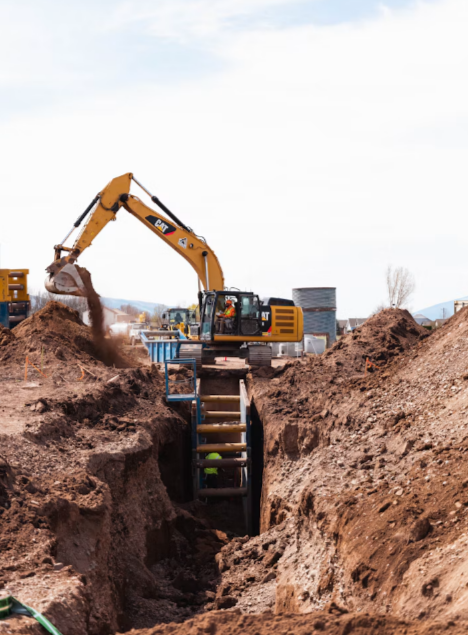
Bluntly, this is going to push a lot more work below ground. Deep drainage is fiddly, risky, and proper specialist work. It needs temporary works design, dewatering, careful sequencing, and people who’ve done it before. It’s not something you hand to whoever has a spare digger.
If you’re unsure what that kind of work involves, have a look at MAC Group Ltd’s deep drainage services. It’s a good picture of the range of kit—attenuation tanks, downstream defenders, gattics, and full site systems—that will become everyday parts of a drainage strategy once connection stops being automatic.
The mistakes I can see coming
I’ve watched this industry react to regulatory change before, so let me be a bit of a prophet of doom for a moment. These are the mistakes I expect to see in the next few years.
Buying land on yesterday’s assumptions. A site with no realistic infiltration, a tiny surface water outfall, and a constrained foul sewer is going to cost a lot more to drain than it used to. If your appraisal assumes a cheap gravity connection to the nearest manhole, you could be overpaying for land you’ll struggle to make work. Get a proper drainage feasibility done before you commit, not after.
Leaving ground investigation too late. You can’t design infiltration without testing infiltration. You can’t size attenuation sensibly without knowing about groundwater, contamination, and soil behavior. Too many schemes still treat the GI as something that happens after planning. That has to change.
Designing drainage around the layout. Most schemes still fix the masterplan first and then try to fit the drainage into the gaps. When drainage carries real weight in planning, it has to sit at the table from the start. Low points, outfall routes, storage locations, and access for maintenance should shape the layout.
Underestimating depth. Deeper attenuation means deeper excavations, and deeper excavations need proper temporary works, shoring, and safety management. They also take longer and cost more. If your program and cost plan assume shallow drainage and the reality is three or four meters down with water in the ground, you’ll get a nasty surprise.
Choosing contractors on price alone. I’ll keep banging this drum. Deep drainage done badly is dangerous, expensive, and very hard to fix after the event. You want someone with the plant, experience, and safety culture to handle it, not just the lowest number on the tender sheet.
What I’d be doing now if I were a developer
Talk is cheap, so here’s what I’d actually do.
Get drainage involved at the land appraisal stage. Before exchange, I’d want a sensible view of how the site drains: where surface water can go, at what rate, how much storage that means, and how deep it’s likely to be. Even a desktop study plus a few trial pits is better than guessing.
Talk to the water company early. Pre-development inquiries cost little and tell you a lot. Capacity information, likely points of connection, and known problems in the catchment are all worth knowing before you’ve designed anything.
Design as if Schedule 3 is already here. Even if it isn’t commenced when you submit, designing to the national SuDS standards now protects you from having to redesign later, and it usually makes the scheme easier to get through planning anyway.
Follow the drainage hierarchy properly. Infiltration first, then a watercourse, then a surface water sewer, and only then a combined sewer, and only with good reason. Planners and flood authorities are already checking this. That scrutiny will only get tougher.
Budget properly for storage and depth. Price in realistic attenuation volumes, flow control, treatment, and deeper excavations. It’s far better to be pleasantly surprised than to find a six-figure hole at the tender stage.
Choose a drainage contractor who can add value early. The best groundworks and drainage contractors don’t just build what’s drawn. They spot buildability problems, suggest better ways to sequence deep work, and help get the design right before it’s set in stone. Bring them in early if you can.
Is this actually a bad thing?
Here’s my honest view, and some developers won’t like it.
I think the automatic right to connect, in its current form, has had its day. Not because developers are villains—most of the sewer problems in this country come from decades of underinvestment and Victorian networks being asked to do far more than they were ever built for. But a system where every new site can add flow to a struggling network without any real responsibility for the consequences was never going to last once the public started caring about rivers.
And the alternative isn’t that bad. Well-designed SuDS and attenuation make sites more resilient, reduce flood risk for the homes you’re building, and can genuinely improve the places people live. Wales has been working under Schedule 3 for years, and houses are still being built there. The early teething problems were real, but the industry adapted.
The developers who’ll struggle are the ones who keep treating drainage as an afterthought. The ones who’ll do well are the ones who see it coming, design for it early, price it honestly, and work with contractors who know what they’re doing below ground.
The bottom line
The automatic right to connect isn’t dead, but it’s living on borrowed time, especially for surface water. Whether the change comes through a water reform bill, through Schedule 3 finally commencing in England, or simply through planners and water companies getting tougher, it’s coming.
When it does, the schemes that sail through will be the ones that hold their water on site, release it slowly, treat it properly, and can show their workings. That means more attenuation, deeper drainage, better flow control, and much earlier thinking.
So my advice is simple. Stop assuming you can just plug into the sewer. Start designing as if you can’t. If you get it right now, you won’t have to explain to your investors in three years’ time why the drainage blew the budget.